
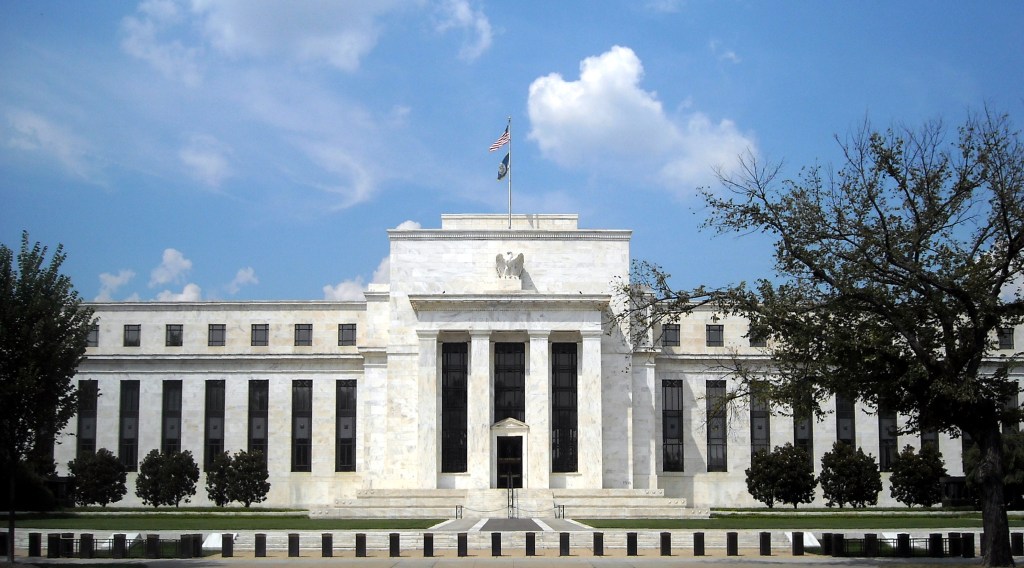
Photo: AgnosticPreachersKid via Wikimedia Commons, licensed under CC BY-SA 3.0.
The August Consumer Price Index report is positioned to become the decisive economic release before the Federal Reserve’s September policy meeting.
One calendar correction matters. The Bureau of Labor Statistics lists the August CPI release for Friday, September 11, 2026, at 8:30 a.m. Eastern time. September 10 is scheduled for the August Producer Price Index report. The Federal Open Market Committee meets September 15–16, leaving policymakers only a few days to assess the CPI data before voting.
Markets are already preparing for a close decision. WalletInvestor reported that traders were pricing close to a 70% chance of a September rate increase, while separate coverage cited roughly 66% odds of a 25-basis-point hike. Those probabilities have moved sharply as Federal Reserve officials have adopted a more forceful tone.
The underlying question is direct: Will August inflation show enough moderation for the Fed to wait, or will it confirm the hawkish case for another increase?
Warsh has shifted the burden onto the inflation data
Federal Reserve Chair Kevin Warsh used his Jackson Hole speech to clarify his position after a less definitive July news conference.
According to CNBC’s report, Warsh reaffirmed the Fed’s 2% PCE inflation objective and said that inflation must be the central bank’s predominant concern. He also stated that broad financial conditions were not sufficiently restrictive.
Warsh did not issue a formal commitment to raise rates. He described himself as committed to a discipline rather than a decision. That distinction is legally and economically significant. It means the chair preserved discretion while making clear that a firm inflation report could justify immediate action.
The market interpreted the speech as hawkish. WalletInvestor’s analysis described August CPI as the hinge for the September decision. Morningstar similarly reported that a September hike remained possible if August CPI and PPI were firm.
Fed Governor Michael Barr then narrowed the debate further. CNBC reported that Barr said he would support a rate hike if inflation failed to ease sufficiently. Barr also said the Fed could take more time if incoming data showed inflation moderating toward 2%.
Barr’s position is conditional, not conclusively supportive of a hike. But it gives the hawkish camp another vote and creates a clear threshold for the August report.

Inflation is cooling, but it is not resolved
The latest CPI report did not establish price stability.
According to CNBC’s coverage of July CPI, headline consumer prices rose 0.1% month over month in July and 3.4% over the prior year. Core CPI, which excludes food and energy, increased 0.2% monthly and 2.5% annually.
Both measures declined from June. Neither reached the Fed’s 2% objective.
Shelter remained a significant contributor. CNBC reported that shelter costs accounted for approximately two-thirds of July’s monthly headline increase. Owners’ equivalent rent increased 0.3%, while the broader shelter index rose 0.1%.
That composition matters. A decline in gasoline prices can reduce headline CPI quickly. It does not necessarily demonstrate that underlying inflation has been defeated. The Fed is therefore likely to scrutinize services, shelter, medical care, transportation, and other categories that are less directly tied to volatile energy markets.
Barr has said inflation has remained above target for nearly five and a half years. The statement refers to the broader inflation experience and the Fed’s preferred PCE measure, not only to the CPI series. The distinction is important, but the conclusion is unchanged: price growth remains materially above the central bank’s stated objective.
What to watch in the August CPI report
1. Core CPI versus headline CPI
Headline CPI includes food and energy. Core CPI excludes both categories to provide a less volatile measure of underlying price pressure.
A weak headline number paired with firm core CPI would be a limited victory for the Fed. It could reflect lower energy prices rather than broad disinflation.
The more consequential result would be a monthly core reading below recent trends, accompanied by slower annual inflation. A core increase around 0.2% would likely keep the hike debate alive. A hotter reading could push September hike odds materially higher.
The Cleveland Fed’s inflation nowcast, cited in market coverage, pointed to an August headline increase of approximately 0.36% to 0.38% monthly and a core increase near 0.20%. Those figures imply headline inflation around the mid-3% range year over year and core inflation around the mid-2% range.
2. Shelter
Shelter is one of the largest components of the CPI basket. It also tends to adjust slowly, which means a sustained decline can take months to appear in the official data.
The Fed will examine whether rent and owners’ equivalent rent are slowing. A deceleration would support the argument that earlier housing-market weakness is finally reaching the inflation data.
A renewed acceleration would complicate the case for a pause. It would also weigh on households directly because rent, mortgage costs, insurance, and housing-related services consume a large share of monthly budgets.
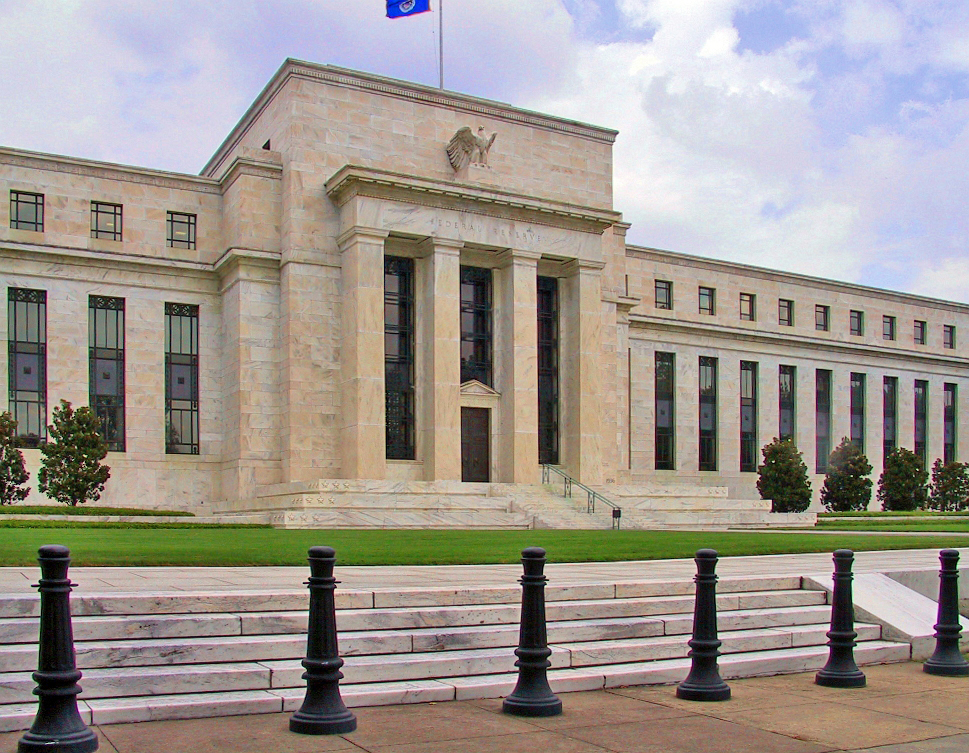
Photo: Dan Smith via Wikimedia Commons, licensed under CC BY-SA 2.5.
3. Services inflation
Services inflation is the central test of whether price pressures are becoming persistent.
Officials will monitor medical care, airline fares, personal services, restaurant prices, insurance, and other labor-intensive categories. Strong services inflation would support Warsh’s argument that recent improvement has not meaningfully changed underlying trends.
A broad slowdown across services would give the Fed room to wait. The committee could argue that restrictive policy is working without imposing another immediate increase.
The labor market provides a second test
The August employment report will influence the September decision, but JPMorgan’s framework places more weight on CPI.
Market coverage citing JPMorgan’s analysis identified 30,000 to 70,000 new jobs as an ideal range. That outcome would suggest a labor market that is cooling without collapsing.
A payroll gain above 70,000 could reinforce concerns that demand remains too strong. It could increase pressure on the Fed to maintain or raise rates.
A result below 30,000 would raise a different problem. The Fed could face a stagflationary environment: weak hiring combined with inflation that remains above target.
The JPMorgan labor-market research portal provides broader background. The current setup leaves little room for an unambiguous “good” report. Moderate employment growth and softer CPI would be the least disruptive combination.
Three CPI scenarios and the likely market reaction

Image: U.S. Treasury document via Wikimedia Commons, public domain.
The table describes market mechanics, not guaranteed outcomes. Equity valuations, oil prices, fiscal policy, geopolitical developments, and Treasury issuance can override the initial CPI reaction.
Mortgage rates also do not move one-for-one with the federal funds rate. They are primarily influenced by longer-term Treasury yields and mortgage-backed securities. A 25-basis-point Fed hike could push mortgage rates higher, but the size of the move would depend on what markets had already priced in.
Savings yields operate differently. Banks may maintain deposit rates temporarily to compete for funds, or cut them rapidly after a pause or eventual easing cycle. Consumers should compare annual percentage yields, withdrawal rules, minimum balances, and account protections rather than relying on the Fed decision alone.

Image: U.S. Navy via Wikimedia Commons, public domain.
Why the odds are moving so quickly
The 66% to 70% hike range should not be treated as a statutory forecast. It is a market-implied probability that changes with futures prices, economic releases, and official comments.
After July CPI, CNBC reported that September hike odds had fallen to approximately 42%. After Warsh’s Jackson Hole speech and Barr’s comments, other reports placed the probability near or above 60%.
That sequence shows the market’s uncertainty. Traders are not responding to a settled policy path. They are repricing the same decision as new information arrives.
Motley Fool coverage was requested for this preview, but no matching article on the August 2026 CPI and Warsh’s September decision was identified in the available research. Readers can consult The Motley Fool directly for its current market commentary. The figures in this article are drawn from the BLS CPI schedule, the Federal Reserve’s FOMC calendar, CNBC, WalletInvestor, and market research cited above.
The bottom line
The August CPI report is not the only evidence before the Fed. It is, however, the final major inflation reading before the September 15–16 meeting.
A soft report could preserve the Fed’s pause. An in-line report would leave the committee divided. A hot core reading, especially one driven by shelter and services, could provide Warsh and Barr with the evidentiary basis for a 25-basis-point hike.
For households, the implications extend beyond financial headlines. The outcome could affect borrowing costs, mortgage affordability, bond prices, stock valuations, and the income available from cash savings.
Why Main Street is not a bank, broker, financial adviser, or investment manager. We do not provide individualized investment, tax, mortgage, or legal advice. Market probabilities are not guarantees, and historical or projected performance does not ensure future results. This independent contributor analysis is for educational and informational purposes only. Verify all figures against primary sources before making a financial decision.
Join on web for more member-owned financial education and market coverage!


Leave a Reply