
Small-business banking changed materially in 2026. Online financial platforms now compete directly with established banks on fees, interest, payment processing, and cash-management tools.
The tradeoff is direct. Fintech platforms often provide better pricing and faster digital workflows. Traditional banks generally provide stronger branch access, cash handling, and established relationship infrastructure.
This ranking compares business checking products by monthly fees, APY, balance limits, transactions, payment tools, cash access, and available user-review evidence. Rates and terms are variable. Confirm the current account agreement before applying.
Quick ranking
How we ranked the accounts
The ranking does not treat APY as the only relevant measure. A business checking account must also handle payroll, vendor payments, taxes, deposits, employee spending, fraud controls, and accounting workflows.
We considered:
- Monthly maintenance fees and waiver requirements.
- APY, balance caps, and activity conditions.
- ACH, wire, check, and transaction costs.
- Cash-deposit and branch availability.
- Team controls, sub-accounts, invoicing, and integrations.
- FDIC disclosures and the distinction between banks and fintech companies.
- Available customer-review information, including whether ratings were product-specific or company-wide.
The available review data is uneven. A rating on Trustpilot may reflect a company’s entire product line rather than one business checking account. Editorial scores are not customer-submitted reviews. Those distinctions matter.
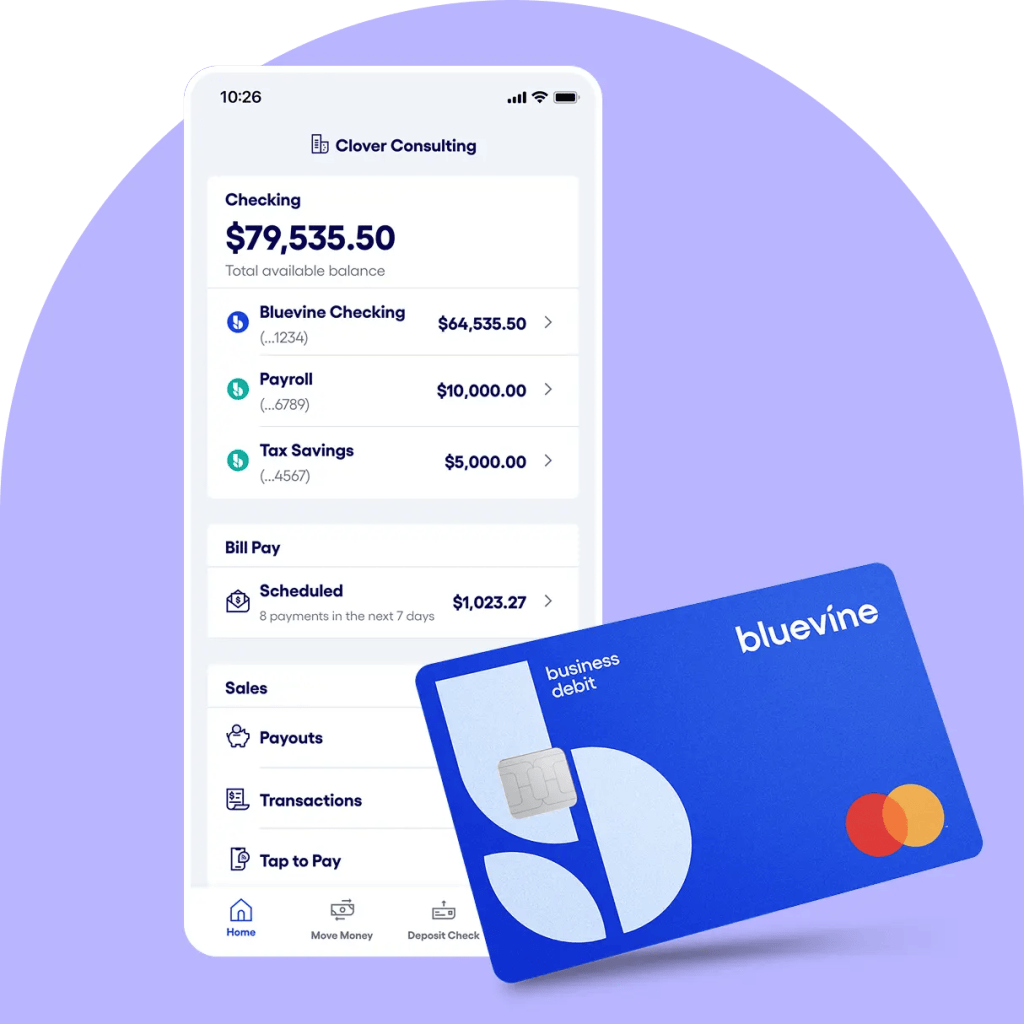
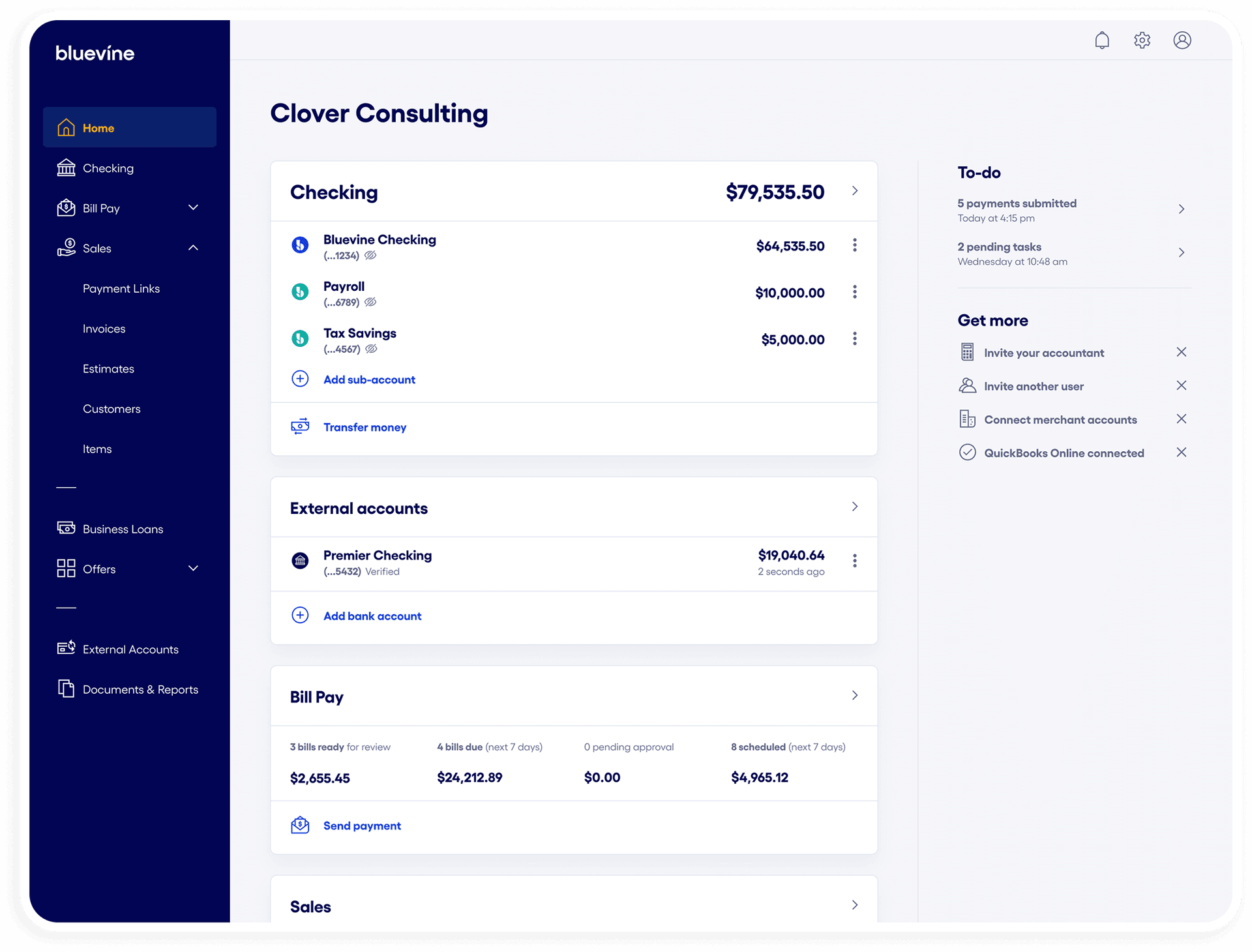
1. Bluevine Business Checking: Best overall
Bluevine ranks first because its Standard plan combines no monthly fee, no minimum balance requirement, unlimited transactions, and a competitive APY.
According to Bluevine’s current account page, the Standard plan pays 1.30% APY on balances up to $250,000 when the account holder meets one monthly activity requirement. The business must either spend $500 per month with the Bluevine debit card or receive or deposit $2,500 in customer payments.
Bluevine’s Plus plan costs $30 per month and pays 1.75% APY on up to $250,000. The Premier plan costs $95 per month and pays 3.00% APY on all balances, according to the provider’s published schedule.
Pros
- No monthly fee on the Standard plan.
- No minimum balance requirement.
- No overdraft fee.
- Unlimited transactions.
- Sub-accounts for budgeting and cash allocation.
- Employee debit cards with spending limits.
- Invoicing, bill pay, ACH, and mobile check deposit.
- Advertised FDIC protection up to $3 million through participating program banks.
Cons
- The Standard APY requires monthly activity.
- There are no traditional branches.
- Certain wire and international-payment fees apply.
- Customer complaints include account holds and compliance reviews.
Bluevine’s page reported a 4.7 out of 5 Trustpilot rating based on 11,409 reviews at the time of research. That is a strong overall score, but the review record is not uniformly positive. Independent review summaries and complaint forums identify recurring allegations involving sudden account freezes, deposit holds, and difficulty obtaining timely escalation during fraud or compliance reviews.
Bluevine is a financial technology company, not a bank. Banking services are provided through Coastal Community Bank and other program banks, Members FDIC. The distinction is statutory and important.
2. American Express Business Checking: Best for simple high-yield checking
American Express Business Checking is the strongest alternative for businesses that want interest without a monthly maintenance fee.
The official American Express business checking page lists 1.30% APY on balances up to $500,000. No interest is paid on balances above that cap. The account has no monthly maintenance fee and no minimum balance requirement, according to current published terms.
Pros
- $0 monthly maintenance fee.
- 1.30% APY up to $500,000.
- No minimum balance requirement.
- No cost to open the account.
- Familiar financial brand and digital account management.
Cons
- No cash deposits.
- No branch network for business checking customers.
- Limited fit for cash-heavy retailers and restaurants.
- APY is variable and can change without notice.
NerdWallet’s 2026 editorial review assigned American Express Business Checking a 4.8 out of 5 rating. That is an editorial evaluation, not a customer-review score. Broader Trustpilot ratings for American Express cover cards, travel, and other products and should not be treated as a direct measure of this checking account.
American Express Business Checking is best suited to consultants, agencies, online sellers, creators, and professional-service firms that receive electronic payments and rarely handle physical cash.
3. Found Business Banking: Best for freelancers and tax organization
Found is not simply a checking account. It is a banking, bookkeeping, invoicing, and tax platform designed primarily for freelancers and small one-owner businesses.
The Found pricing page lists a free plan with business banking, a debit card, up to 20 sub-accounts called Pockets, expense categorization, receipt scanning, tax estimates, contractor payments, and unlimited invoicing.
The paid plans add interest:
- Found Plus: $35 per month or $315 annually; 1.50% APY on balances up to $20,000.
- Found Pro: $80 per month or $720 annually; 2.50% APY on all balances with no cap.
Pros
- Free base plan.
- Integrated bookkeeping and tax estimates.
- Unlimited invoicing.
- Contractor payments and 1099 filing tools.
- Multiple sub-accounts for taxes and operating reserves.
- No minimum balance requirement.
Cons
- The free plan does not pay APY.
- Plus and Pro subscription fees can exceed the value of the interest earned.
- The highest-yield plans are most useful when the included software replaces other paid tools.
- Found is not a conventional branch-based bank.
Found’s subscription economics require scrutiny. A business holding $20,000 would earn approximately $300 annually at 1.50% APY before tax and rate changes. That does not independently justify a $420 annual Plus subscription. The software and tax features must create additional value.
We did not identify a comparable, verified current customer-review score for Found Business Banking during this research. That limitation is disclosed rather than replaced with an unsupported rating.

4. Axos Business Interest Checking: Best traditional-bank alternative
Axos Bank’s Business Interest Checking account is designed for businesses that want an interest-bearing checking account from a chartered online bank rather than a fintech platform.
According to Axos’s published account information, the account offers up to 1.01% APY. The published rate schedule is tiered:
- 1.01% APY on balances below $50,000.
- 0.20% APY on balances from $50,000 to $249,999.99.
- 0.10% APY on balances from $250,000 to $4,999,999.99.
The monthly fee is $10, and it can be waived with a $5,000 average daily balance. The minimum opening deposit is $100.
Pros
- Interest-bearing business checking.
- Fee waiver at a $5,000 average daily balance.
- Traditional bank structure.
- Online banking and business account services.
Cons
- APY declines substantially at higher balances.
- The account is not designed around a large branch network.
- The highest advertised rate applies only to smaller balances.
- We did not identify a sufficiently comparable current user-review dataset to assign a review score.
Axos may be appropriate for an established business that can maintain the waiver balance and wants a bank relationship. It is less compelling for a business seeking maximum yield on six-figure operating cash.
5. Relay: Best for cash allocation and team controls
Relay is a financial technology platform built around multiple checking and savings accounts, spending controls, approval workflows, and accounting integrations.
The Relay pricing page lists:
- Starter: $0 per month; 1.11% APY on savings accounts.
- Grow: $30 per month; 1.75% APY on savings accounts.
- Scale: $90 per month promotional pricing, normally listed at $120; 3.00% APY on savings accounts.
The APY applies to savings accounts, not ordinary checking balances. That distinction should not be overlooked in an account comparison.
Pros
- Up to 20 checking accounts on Starter and Grow.
- Up to 50 checking accounts on Scale.
- Built-in spend controls.
- Approval workflows and accounting integrations.
- Invoicing and bill-management tools.
- Strong fit for Profit First-style cash allocation.
Cons
- The highest APY requires a paid plan.
- Savings yield is not the same as checking yield.
- Additional transaction fees apply.
- Account reviews and holds appear in a recurring minority of customer complaints.
Relay’s Trustpilot rating has been reported in the roughly 4.3-to-4.6 range, with several thousand reviews, depending on the date and snapshot. Positive reviews commonly cite the platform’s interface and customer support. Negative reviews allege frozen accounts, delayed transfers, and slow compliance reviews.
Relay is a financial technology company, not an FDIC-insured bank. Banking services are provided by Thread Bank, Member FDIC. Customers should review pass-through insurance conditions and avoid assuming that every balance or product receives identical coverage.
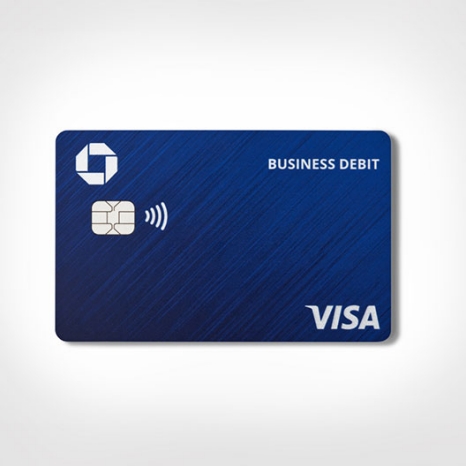
6. Chase Business Complete Banking: Best for branches and cash deposits
Chase ranks sixth because it does not compete primarily on APY or no-fee banking. It competes on physical access, cash deposits, payment acceptance, and breadth of business services.
The Chase Business Complete Banking page lists a $15 monthly service fee. Chase provides several waiver methods, including maintaining a $2,000 minimum daily ending balance, meeting eligible payment or card-spend requirements, or maintaining certain linked accounts.
The account includes Chase QuickAccept, mobile deposits, bill pay, branch access, fraud monitoring, and up to $5,000 in in-branch cash deposits per statement cycle without an additional charge, subject to published terms.
Pros
- Large branch and ATM network.
- Cash deposits and in-person banker access.
- QuickAccept card-payment functionality.
- Fraud controls and account alerts.
- Broad business banking ecosystem.
Cons
- Monthly fee unless waived.
- Not a high-yield checking account.
- Additional fees can apply after included transaction and cash-deposit limits.
- Businesses may sacrifice yield for physical access.
Final verdict
For most digital-first small businesses, Bluevine Business Checking is the strongest overall choice because it combines a free Standard plan, interest potential, payment tools, and flexible sub-accounts.
American Express Business Checking is the cleaner choice for businesses holding up to $500,000 that want no monthly fee and no activity requirement for the advertised account structure.
Found is more valuable when bookkeeping and tax automation are central to the business. Axos is a reasonable traditional-bank alternative for businesses that can maintain the fee waiver. Relay is strongest for structured cash allocation and team approvals. Chase remains the practical choice for businesses that deposit cash or need branches.
No account eliminates operational risk. A small business should maintain documented ownership records, current identification, business formation documents, and a secondary payment pathway. This article is for general educational purposes. Why Main Street is not a bank, financial advisor, broker, accountant, or law firm, and is not responsible for account approval decisions, rate changes, provider actions, service interruptions, or the accuracy of third-party reviews. Read the provider’s current disclosures and account agreement before applying.
Sources
- Bluevine Business Checking
- American Express Business Checking
- Found Pricing and Plans
- Axos Business Interest Checking
- Relay Pricing
- Chase Business Complete Banking
- NerdWallet: American Express Business Checking Review
- NerdWallet: Bluevine Business Checking Review
- Trustpilot: Bluevine
- Trustpilot: Relay


Leave a Reply