
Photo: Notorious4life, CC0, via Wikimedia Commons.
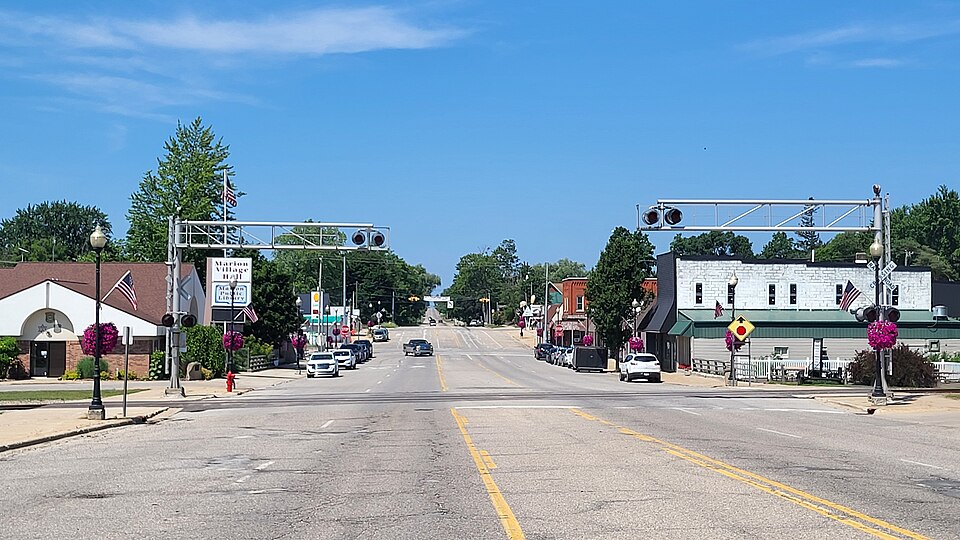
A small village in Osceola County has produced an unusually large economic signal.
Six businesses opened in Marion during August 2026, according to Cadillac News. The openings added salons, fishing supplies, food service, specialty retail and health care to a commercial district that still contains vacant storefronts.
The development is notable because the reported catalyst was not a major tax abatement, relocation package or large corporate investment. Nicole Johnson, president of the Marion Village Chamber of Commerce, attributed the activity to local pride and residents’ determination to rebuild the community.
That distinction matters. Marion’s experience is not a statutory guarantee that every rural downtown can replicate the same result. It is, however, a useful case study in how modest businesses can collectively change the economic posture of a small town.
Marion Before the August Opening Wave
Marion is a village in Osceola County, Michigan. The U.S. Census Bureau profile referenced by Wikipedia records a 2020 population of 789. The village covers roughly 1.4 square miles and sits within Marion Township.
Its commercial identity is typical of many northern Michigan communities. Main Street businesses serve residents, travelers, families, outdoor enthusiasts and nearby rural households. The local chamber directory lists food, clothing, insurance, health care, automotive, retail and community-service businesses.
The village also has a documented industrial and civic history. Marion’s origins are tied to logging, a sawmill and a general store. The Marion Mill Pond remains one of the community’s historic landmarks.

Photo: rossograph, CC BY-SA 4.0, via Wikimedia Commons.
The baseline is important. Marion was not a blank redevelopment site. It already had established businesses, public institutions and local organizations. The August openings built on that existing foundation.
The Six Businesses That Opened in August
The Cadillac News report identifies six businesses that opened during August:
- The Wash House Salon
- La Rue’s
- Hooked Up Fishing Bait and Tackle
- M-115 4 Corners Diner, identified in the Cadillac News photo captions as M-115 4 Corners Grill
- Northern Glass and Vape
- Hometown Health and Allergy
The businesses do not represent one narrow industry. That is part of the economic significance.
The Wash House Salon and La Rue’s add personal-care services. Hooked Up Fishing serves outdoor recreation and local anglers. M-115 4 Corners provides a dining option near a major road junction. Northern Glass and Vape adds specialty retail. Hometown Health and Allergy expands access to a health-related service.
The group fills practical gaps rather than chasing a single trend. That is often how rural commercial districts regain daily foot traffic: one service at a time.

Photo: Notorious4life, CC0, via Wikimedia Commons.
The Businesses That Came Before Them
The August openings followed other recent additions.
Cadillac News reported that Archie’s Pizza had recently opened in Marion. The article also described the Olde Mill Venue, which opened in 2020, as part of the village’s continuing commercial growth.
The reporting brief for this article also identifies the Marion Bake Shoppe, a woman-owned bakery that opened on North Main Street. That detail was not independently confirmed in the accessible public sources reviewed for this article and should be treated as a reported local-business claim rather than a conclusively verified fact.
The same caution applies to the headline’s “farm-to-table kitchen” reference. The available Cadillac News report confirms the M-115 diner and discusses plans to convert the granary portion of the Olde Mill property into the Olde Mill Tavern. It does not independently establish that a farm-to-table kitchen is operating. Readers should not treat that description as a verified operating fact without additional documentation from the business.
That distinction is not cosmetic. Rural economic reporting often turns early plans into established facts. A planned restaurant is not an open restaurant. A local concept is not necessarily a formal farm-to-table operation. The record should remain clear.
Community Investment Instead of a Large Incentive Package
The central claim in the Cadillac News report is straightforward: Marion’s current activity was community-driven.
Johnson said there was no single relocation incentive or major tax deal behind the openings. Instead, she cited a stronger sense of community and a desire to make Marion successful.
That account is consistent with the structure of the businesses. The openings are locally scaled. They occupy existing commercial space. They address recognizable local needs. Several are operated by younger entrepreneurs, while Hometown Health and Allergy was reportedly started by Marion native Marcia Hammar after operating elsewhere.
This is not a finding that public incentives are ineffective. It is a finding about sequence. In Marion, private individuals appear to have moved first, using local knowledge to identify opportunities that larger developers might have ignored.
The economic effects can accumulate:
- A new salon creates appointment traffic.
- A diner generates morning and midday visits.
- A fishing store captures seasonal recreation spending.
- A health practice keeps some service spending closer to home.
- Specialty retail adds another reason to stop in the village.
- More occupied storefronts can improve investor confidence.
No single storefront has to carry the entire downtown. The district benefits from the combined effect.
Michigan’s Larger Downtown-Revival Backdrop
Marion’s story arrives as Michigan is expanding its support for small downtown businesses.
On June 23, 2026, the Michigan Economic Development Corporation announced more than $1.5 million in Match on Main grants for 69 small businesses. The state said the awards were expected to create 117 full-time jobs and 221 part-time jobs while activating more than 210,000 square feet of vacant or underused commercial space.
The program provides up to $25,000 for eligible new or expanding businesses in qualifying downtowns and commercial corridors. The FY26 application cycle attracted 144 applicants from 83 communities.
The published award list includes businesses in Cadillac and other Michigan communities. It does not establish that Marion received a Match on Main award for the six businesses discussed here. That point must not be inferred.
The broader lesson is still relevant. State grants can reduce the cost of buildout, equipment, accessibility improvements and façade work. Local entrepreneurs can supply the business idea, labor and risk tolerance. Strong downtowns often require both forms of capital, but they do not always arrive at the same time.
What Other Small Towns Can Learn From Marion
Marion’s experience offers five practical lessons.
1. Start With Visible Needs
Laundry, food, personal care, fishing supplies and health services are not abstract economic-development concepts. They are daily or seasonal needs. Businesses that solve concrete problems have a clearer path to local customers.
2. Use Existing Storefronts
Opening in an existing building can lower the initial capital requirement compared with ground-up construction. It also improves the appearance and functionality of the downtown immediately.
3. Build a Cluster, Not a Single Attraction
One new business can struggle to generate sustained traffic. Six businesses operating within the same small commercial ecosystem create more reasons for residents and visitors to return.
4. Treat Local Identity as Economic Infrastructure
Johnson’s comments point to an intangible but material asset: community pride. That pride can influence whether residents shop locally, landlords improve buildings and entrepreneurs believe a storefront is worth the risk.
5. Separate Confirmed Facts From Future Plans
Marion still has vacant storefronts. The Olde Mill Tavern remains a planned project, and the Frosty Freeze is reportedly under new ownership and being renovated. Those developments may matter, but they are not complete until the doors open and operations begin.
That evidentiary standard protects both businesses and residents from inflated expectations.
Marion’s downtown is not fully rebuilt. The record supports a narrower conclusion: six August openings created a measurable burst of commercial activity, followed earlier additions such as Archie’s Pizza and the Olde Mill Venue, and changed the tone of the village’s business district.
The town’s revival is therefore not a completed verdict. It is an ongoing local investment case.
For more reporting on small-business development, economic trends and community wealth building, visit Why Main Street’s news section and Current Events coverage. Why Main Street is a member-owned social media company. It is not a bank, lender, investment adviser or municipal authority. This article is for general informational purposes, and Why Main Street does not guarantee the accuracy, completeness or continued operation of any business discussed. Verify openings, hours, licensing and services directly with the businesses or local officials.
Sources and Verification Notes
- Cadillac News: “Six New Businesses Bring Renewed Energy, Community to Marion”
- Michigan Economic Development Corporation: Match on Main Grants
- Marion, Michigan ; Wikipedia
- Wikimedia Commons: Category: Marion, Michigan
- Marion Area Chamber of Commerce
- Accessible searches of FingerLakes1, ABC12 and Lake County Star did not produce corroborating coverage of the six August openings. They are not treated as confirming sources in this article.


.jpg)


Leave a Reply