
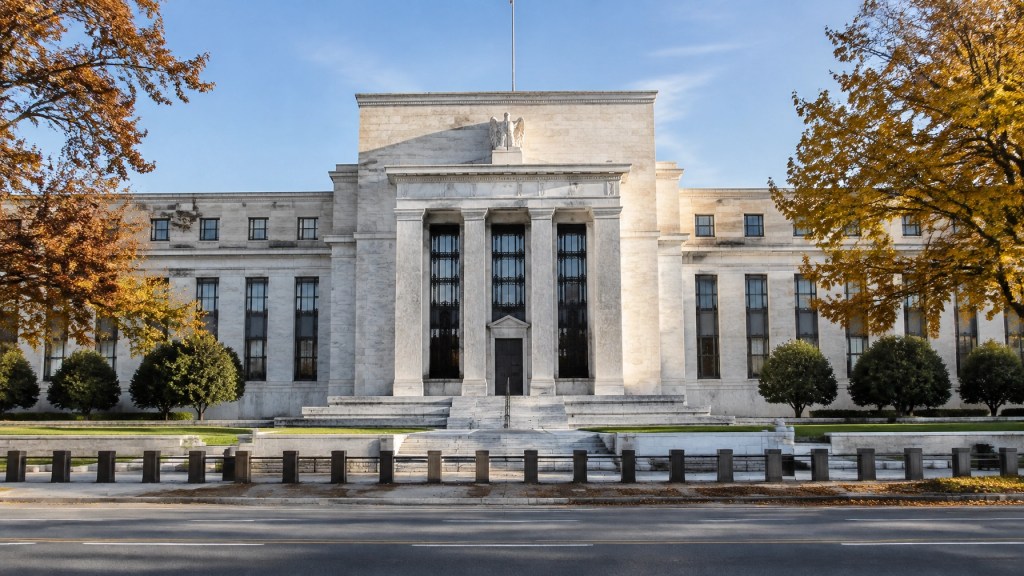
The Federal Reserve meets October 27–28. As of October 17, markets put the chance of no rate change at about 84%. They see roughly a 16% chance of a quarter-point hike.
The current target range is 3.75% to 4.00%. That followed a September increase: the first rate hike since 2023.
So what does this mean for your money? The Fed’s rate is like the cost of shipping to a store. When shipping gets more expensive, many prices in the store can move too. The Fed does not set every price, but its decisions can affect savings, debt, mortgages, and business loans.
What the Fed actually does
The Fed sets a target for the federal funds rate. That is the rate banks charge each other for overnight loans.
Think of the Fed’s rate as the basic price of money. It can influence the rates banks offer or charge, though it does not control every rate directly.
The Fed raises rates to cool demand and help slow inflation. In that sense, higher rates act like a brake. The Fed cuts rates to support borrowing and spending when the economy weakens. That is more like pressing the gas.

The latest inflation numbers help explain why markets are watching closely. In September, consumer prices were up 3.7% from a year earlier. Producer prices, a measure of prices received by businesses, were up 6.3%. Those figures do not decide the Fed’s move by themselves, but they help shape the debate.

AI-generated illustration.
What is a basis point?
A basis point is one-hundredth of a percentage point. So 100 basis points equal one percentage point.
A 25-basis-point hike means an increase of 0.25 percentage points. That sounds small. But it can affect the cost of millions of loans, so a small change can add up across the economy.
What is likely to happen October 27–28?
Market pricing on October 17 pointed to a hold. The Investing.com Fed Rate Monitor showed roughly an 84% chance of no change and about a 16% chance of a 25-basis-point hike. A separate tracker showed a similar split, with a small chance of a cut.
But these are market guesses, not promises. Prediction markets and futures prices reflect what traders think may happen. The Fed makes the decision.
Some economists also see this meeting as a closer call than the odds suggest. MarketWatch reported that recent inflation data and changing market expectations have kept a hike in play.
In short: markets lean toward a hold, but the Fed has not announced its decision. Rates can also move before the meeting as new information changes expectations.
What a hold could mean for your savings
Savings rates often respond to Fed policy, but banks choose what they pay. A hold could keep high-yield savings rates relatively strong while making further increases less likely. It does not guarantee that your bank will keep its current rate.
Some top advertised savings accounts were offering around 4.25% to 4.50% APY in October. APY, or annual percentage yield, estimates how much an account earns in a year, including the effect of compounding. Top rates may have limits, eligibility rules, or promotional conditions.

If you are comparing accounts, check the rate, fees, minimum balance, and withdrawal rules, not just the biggest number in an ad. See our 2026 high-yield savings account ranking.

AI-generated illustration.
What it could mean for your credit cards
Many credit cards have a variable APR. APR is the yearly cost of borrowing, including interest and certain fees. Variable means the rate can change.
Many card rates are tied to the prime rate. Prime is a benchmark rate banks set for their most creditworthy customers. Banks often adjust it when the Fed moves.
If the Fed holds, card rates may stop rising because of that particular decision. But a hold does not make existing rates fall. Bankrate’s average for new card offers was about 19.67% in mid-October. Your own rate may differ.

If you carry a balance, interest can keep adding to what you owe. Paying down variable-rate debt can reduce that cost, whatever the Fed decides. For an explanation of how rates and market worries can affect investments, read our coverage of market-rate fears.
What it could mean for your mortgage
Here is the important complication: the Fed does not set the rate on a new 30-year fixed mortgage.
Mortgage rates tend to follow longer-term bond yields, especially the 10-year Treasury. A Treasury yield is the return investors demand to lend money to the U.S. government. Lenders also consider their own costs, risks, and profit margins.
As of October 16, the 10-year Treasury yield was about 5.09%, and the 30-year yield was about 5.43%, according to U.S. Treasury data. A national mortgage-rate survey showed a 30-year fixed rate around 7.19% on October 16. Your quote could be higher or lower, depending on your credit, down payment, loan type, and lender.
That is why a Fed hold does not guarantee a lower mortgage rate. Bond yields can still rise or fall. If you are shopping for a home, compare written offers from multiple lenders. The difference between lenders may matter more than this month’s Fed decision. Our housing affordability coverage looks at the wider cost picture.

AI-generated illustration.
What it could mean for a small business loan
Some small-business loans have variable rates. Some have fixed rates.
A variable business credit line or adjustable-rate loan may use prime as a starting point. If prime changes, your rate could change too, based on the loan’s terms. Many SBA 7(a) variable-rate loans use a permitted base rate, such as prime, plus an added amount.

A fixed-rate loan works differently. Its rate is set for a period and does not automatically change after a Fed announcement. New fixed-term loans may still get more expensive if longer-term borrowing costs rise.
For a business owner planning to borrow, a hold may offer a little more short-term predictability. It is not a promise that rates will fall later. Ask the lender whether the rate is fixed or variable, what benchmark it follows, and when it can reset.

AI-generated illustration.
The short version
> TL;DR: A Fed hold could keep savings rates relatively high, but your bank sets your account’s rate. Credit cards may stay expensive. Fixed mortgage rates follow the bond market, not the Fed alone. Variable business loans may respond to prime, while fixed loans offer more predictable payments.
For more plain-language financial education, see our retirement guide.
Sources and notes
- Federal Reserve: October 2026 meeting calendar
- Federal Reserve: Open market operations and policy actions
- Federal Reserve: Does the Fed set the prime rate?
- St. Louis Fed: How Fed funds changes can affect other rates
- BLS: September 2026 Consumer Price Index
- BLS: September 2026 Producer Price Index
- MarketWatch: Why the October decision may be a closer call
- Investing.com: Fed Rate Monitor
- U.S. Treasury: Daily interest-rate data

Why Main Street is a member-owned social media and financial education platform. It is not a bank, financial institution, or financial adviser. This article is for general information only, not financial advice. Rates and market expectations can change. Please consult a qualified professional about your specific situation.


Leave a Reply