
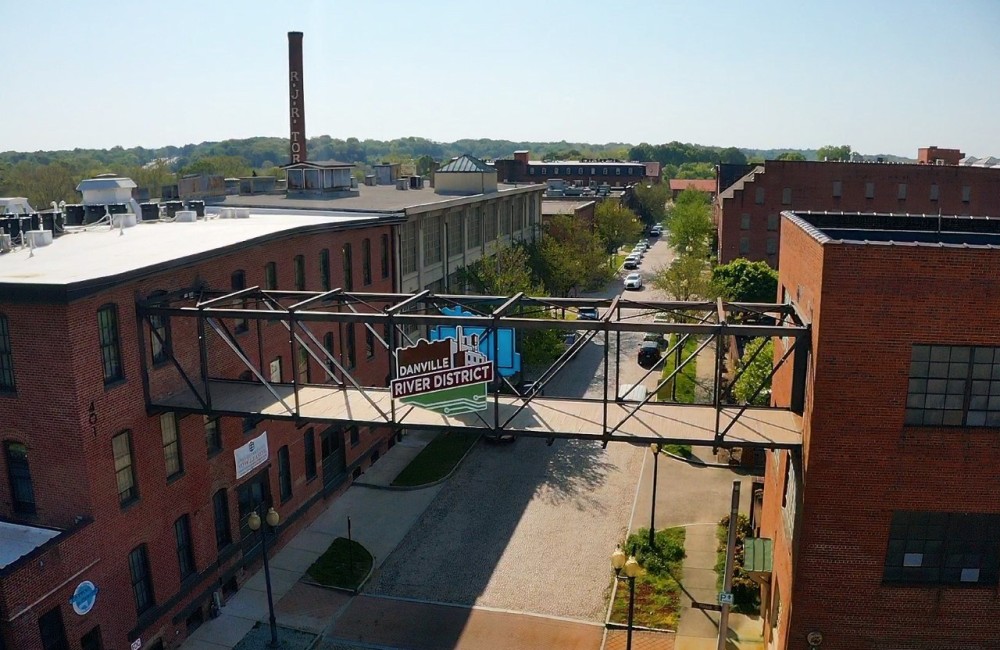
Photo courtesy of River City TV via Main Street America.
Danville, Virginia, did not revive its downtown through a single employer, one grant, or a ceremonial redevelopment plan.
It rebuilt its economic base by treating vacant warehouses, abandoned mills, sidewalks, housing, small businesses, and public spaces as parts of the same system.
That strategy transformed the city’s historic core into the River District. It also earned the River District Association the 2023 Great American Main Street Award, a national recognition for preservation-based commercial district revitalization.
The award was based on more than appearances. Main Street America reported $362 million in public and private reinvestment, 150 net new businesses, and 3.58 million square feet of rehabilitated buildings and structures.
Danville’s experience offers a practical case study for other towns facing mill closures, population loss, empty storefronts, and declining tax bases.
Danville’s first economy was built on tobacco and textiles
Danville was once a major tobacco and textile center in Southern Virginia. Tobacco warehouses and mills lined the Dan River. Those facilities generated jobs, supported merchants, and gave the city a clear economic identity.
That model weakened over several decades.
Textile operations declined. Dan River Mills eventually closed in 2006. Warehouses emptied. Manufacturing jobs disappeared. Parts of downtown became what local residents described as a ghost town.
The problem was not limited to vacant buildings. A declining downtown affected the city’s credibility. As former Danville economic development director Telly Tucker told Cardinal News, an outside business prospect once drove through downtown, saw boarded-up buildings, and decided Danville was not the right place to invest.
That moment exposed the central issue: A city asking private companies to invest must also demonstrate that it is willing to invest in itself.
The River District became the test case
Danville’s response was targeted rather than scattered.
The city and its partners concentrated on the historic downtown, tobacco warehouse district, and industrial properties along the river. The area was branded the River District and placed under a long-term redevelopment strategy.
The River District Association, founded in 1999, coordinated the effort with city agencies, property owners, businesses, institutions, and community stakeholders. Its work follows the Main Street model’s four broad functions: organization, promotion, design, and economic vitality.
The city also created the River District Redevelopment Plan in 2011. Its objectives were straightforward:
- Eliminate visible blight.
- Create a critical mass of residents and businesses.
- Add lifestyle amenities that would bring people downtown beyond working hours.
This was not a promise that every property would succeed. It was an operating framework for deciding which properties, streets, infrastructure projects, and incentives deserved priority.

Danville’s parks and bike-share program support public gathering and pedestrian activity. Photo courtesy of Laura Ashworth via Main Street America.
Public investment came before private confidence
The city’s most controversial move was acquiring distressed properties.
Danville’s Industrial Development Authority bought vacant or deteriorated buildings, assembled parcels, stabilized properties, and prepared them for redevelopment. Critics questioned why public money was being used to purchase old buildings with limited immediate value.
Officials argued that the properties had strategic value beyond their current tax assessments.
The city also invested in streetscapes, sidewalks, parking, infrastructure, public spaces, and broadband. These improvements addressed a basic economic problem: Developers could not be expected to create an active district if the surrounding environment remained inaccessible or visibly abandoned.
One example was Newton’s Landing, a former brownfield site. The city ultimately converted it into a parking area with roughly 400 spaces. The project was not glamorous, but developers reportedly viewed parking as a prerequisite for renovating nearby buildings.
The calculation was statutory and economic, not sentimental. The city was attempting to remove obstacles that private capital could not solve alone.
According to Cardinal News, a city analysis of 17 historic tax-credit projects found that the properties generated approximately $25,520 in annual real estate tax revenue before redevelopment. After completion, those same projects generated approximately $480,502 annually.
That figure does not prove that every public investment will produce the same return. It does show why a narrow, short-term assessment of redevelopment costs can be incomplete.
Historic warehouses became apartments, restaurants, and offices
The River District’s signature tactic was adaptive reuse.
Old tobacco warehouses were not treated only as relics. They became housing, offices, restaurants, breweries, entertainment venues, galleries, and retail spaces.
On Craghead Street, developer Rick Barker acquired and redeveloped multiple buildings. The projects included a corporate headquarters, apartments, restaurants, and commercial space. One block that had been heavily vacant was gradually converted into a mixed-use area.
Other projects repurposed former mills. The White Mill redevelopment, known as Dan River Falls, became part of a broader effort to return residential and commercial activity to the riverfront.
This strategy created a market for small businesses. Restaurants and retailers need customers. Customers need reasons to visit. Residents need housing within walking distance. Employers need an attractive environment for workers.
The projects were therefore interconnected. A restaurant alone could not revive the district. Housing alone could not create a complete downtown. Public spaces alone could not replace private commerce.
The River District required all of them.

Small-business openings became part of the district’s redevelopment activity. Photo courtesy of River District Association via Main Street America.
The measurable results are substantial
Main Street America reports that since 2010, the River District leveraged $52 million in public investment to attract $310 million in private investment.
The same source reports:
- More than 150 new businesses
- More than 1,200 residential spaces
- 3.58 million square feet of rehabilitated buildings and structures
- $362 million in total public and private reinvestment
Virginia Main Street separately reports 623 jobs created or retained, 146 new or expanded businesses, more than $113 million in private investment, and nearly 1,000 downtown housing units through its 25-year review.
Those figures use different reporting periods and definitions. They should not be added together as though they measure one identical program. They do, however, establish the scale of the transformation.
The district also gained public amenities, events, bike infrastructure, green space, arts programming, restaurants, and entertainment. The result was not simply a prettier downtown. It was a more functional local economy.

Dan River Falls redevelopment project. Photo courtesy of River City TV via Main Street America.
Small-business support was part of the strategy
Danville did not rely exclusively on outside developers.
The River District Association created programs designed to help entrepreneurs understand financing, operations, marketing, and business planning. Its Dream Launch initiative provided free startup training and distributed grants to participating entrepreneurs.
According to Main Street America, the program’s bootcamp series trained more than 465 participants beginning in 2018, with 200 completing all six classes. The organization also reported $375,000 in grants distributed through the program.
That matters because a downtown revival can fail if it produces attractive buildings without producing locally owned businesses.
For entrepreneurs, the lesson is direct: Location is only one part of the equation. A small business needs a customer base, manageable occupancy costs, financing, technical support, and a district that produces regular foot traffic.
Readers researching small-business finance can also review Why Main Street’s financial education and wealth-building community. Why Main Street is not a bank, lender, broker, or financial adviser. Information on this platform is for educational purposes and is not a recommendation to invest, borrow, or enter a commercial agreement.
Affiliate and commercial-link disclosure: Some links on Why Main Street may generate compensation for the platform without changing the reported facts or the price paid by the reader. Review all terms independently.

Dream Launch participants receive seed funding. Photo courtesy of River District Association via Main Street America.
Six lessons other towns can use
1. Choose a district and establish priorities
Danville did not attempt to redevelop every block at once. It concentrated resources in a visible, historically significant area with the potential to influence surrounding neighborhoods.
2. Preserve buildings when reuse is economically viable
Historic preservation is not only a cultural objective. Brick warehouses can provide distinctive space for housing, offices, restaurants, and retail. Historic tax credits and other incentives can improve project feasibility, subject to eligibility and statutory requirements.
3. Fix basic infrastructure before demanding private investment
Sidewalks, parking, broadband, signage, lighting, and public spaces are economic infrastructure. They reduce friction for customers, residents, and developers.
4. Use public ownership strategically
A city does not need to become a permanent landlord. It can acquire, stabilize, and reposition properties, then require credible financing and development plans before transferring them to private parties.
5. Build a resident base
Retail and entertainment cannot depend only on occasional visitors. Danville added more than 1,000 residential spaces in the broader redevelopment effort, creating customers who could live near the businesses they patronize.
6. Measure the results and disclose the limits
Business openings, housing units, jobs, private investment, tax revenue, volunteer hours, and building rehabilitation should be tracked. Claims should be separated from verified results. A ribbon-cutting is not proof of economic success; sustained occupancy, payroll, sales, and tax-base growth are stronger evidence.
Danville’s revival is a model, not a guarantee
WDBJ7’s report, “Rebirth of the River District: How Danville became the comeback city,” presents the transformation as an inspiring economic revival. The description is justified, but the legal and economic record remains more precise than the slogan.
Danville faced skepticism. It made unpopular acquisitions. It committed public funds before every private return was visible. It relied on historic preservation, public-private partnerships, local entrepreneurs, and a long-range plan that survived political and economic cycles.
The city did not restore its old tobacco economy. It built a different one on the physical assets that remained.
That is the central lesson for other Main Streets: Economic revival rarely begins with a perfect project. It begins when a community identifies a strategic district, accepts scrutiny, establishes measurable objectives, and continues investing after the first round of criticism.
Why Main Street is an independent, member-owned social media and financial education company. It is not responsible for the accuracy, completeness, or future performance of any city redevelopment program, business, developer, grant, tax credit, or investment. Readers should consult qualified legal, tax, accounting, and financial professionals before acting on any commercial or financial information.


Leave a Reply