
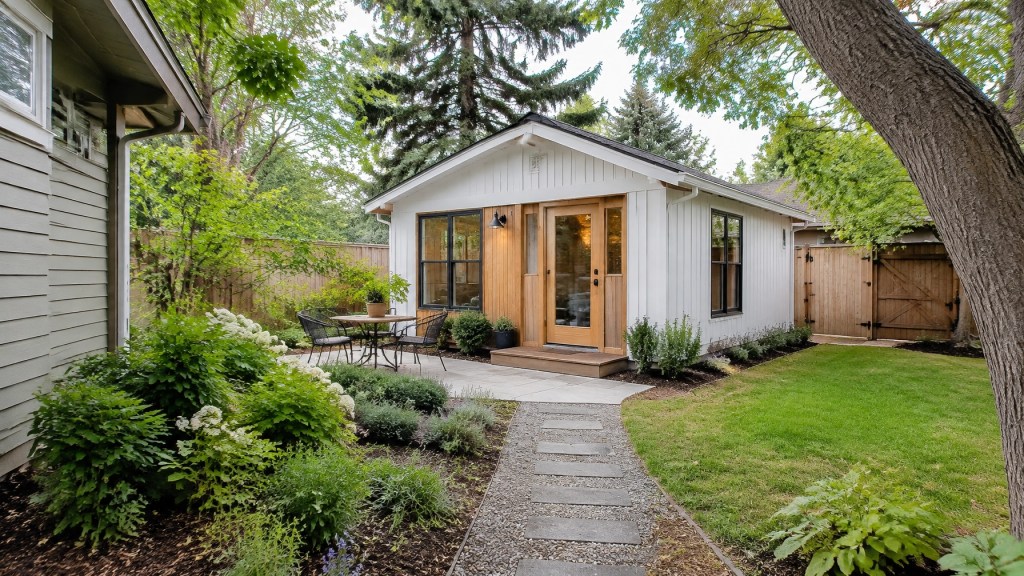
A backyard cottage and a smaller house on a smaller lot are two ways to add homes without starting with a large apartment complex. In a report published October 21, Pew Charitable Trusts found that 80% of large U.S. cities allow accessory dwelling units, or ADUs. But permission on paper does not guarantee construction: 43% of cities that allow ADUs still have major restrictions, and cities with more permissive rules issued 81 ADU permits per 100,000 residents in 2025. (Pew)
The distinction matters. A city can legalize an ADU while keeping rules that make it difficult or costly to build one. Meanwhile, Massachusetts voters will decide on November 3 whether to make smaller-lot single-family homes easier to build in many communities. The ballot measure, called Question 7, would allow qualifying homes on lots as small as 5,000 square feet, subject to frontage, water and sewer conditions. (Massachusetts Secretary of the Commonwealth)

These policies are not guaranteed fixes for housing affordability. They are attempts to add housing through existing neighborhoods, and their effects will depend on what gets approved, what gets built, and what those homes cost.
What an ADU actually is
An accessory dwelling unit is a smaller, independent home on the same property as a primary home. It may be a detached backyard cottage, a garage conversion, a basement or in-law suite, or a unit built above a garage.
An ADU can house a relative, provide a rental unit, or give a homeowner a way to use space that already exists. The details depend on local rules, construction costs, utility connections, and whether the property can accommodate another home.

Pew’s numbers: legal is not enough
Pew’s October report examines ADU rules in large cities. Its findings show a gap between being allowed and being practical to build.
Of the cities Pew studied, 80% allow an ADU that can be rented or sold to someone outside the property owner’s household. Yet 43% of those cities still impose at least one significant restriction, such as parking requirements or owner-occupancy rules. In cities with more permissive ordinances, officials issued 81 permits per 100,000 residents in 2025. More than 11 times the rate in restrictive cities, according to Pew. (Pew)
Parking minimums can force a property owner to create additional off-street parking. Owner-occupancy rules can limit who may live in or rent out the main home. Fees, discretionary reviews, and limits on where an ADU can go can add more cost or uncertainty.

The takeaway is straightforward: legalizing ADUs is a first step, not the finish line. The rules that follow determine whether permission translates into permits, and whether permits turn into homes.
The California-to-Massachusetts playbook
California illustrates how state law can limit restrictive local rules. Its statewide ADU framework generally requires local ordinances to comply with state standards, while allowing cities to adopt less restrictive rules. That approach does not remove building, safety, or site-specific requirements. It does establish a statewide baseline for local permitting. (California Department of Housing and Community Development)
Massachusetts adopted a similar state-level approach through its 2024 Affordable Homes Act. The law made certain ADUs allowable by right in single-family zoning districts, effective in February 2025.
In its first year, Massachusetts communities reported more than 1,600 ADU permit applications and more than 1,200 permits issued, according to Boston Indicators. The permits covered 217 municipalities. The report cautions that the figures are incomplete: some communities did not report, and many permitted units had not yet been completed. A permit is not the same as a finished home. (Boston Indicators; Mass.gov)

The Massachusetts experience also shows the limits of zoning changes alone. Boston Indicators points to construction costs, financing, and overlapping building, fire, energy, septic, wetlands, and stormwater rules as barriers that can remain after zoning is changed.
Question 7: the small-lot experiment
Massachusetts Question 7 would change state zoning law for qualifying single-family homes. A qualifying lot would need to be at least 5,000 square feet, have at least 50 feet of street frontage, and have access to public water and sewer. The measure excludes Boston, which has its own zoning system. Communities could retain reasonable rules on matters such as building height, setbacks, open space, parking, and short-term rentals. (Massachusetts Secretary of the Commonwealth; WBUR)
Supporters say smaller minimum lot sizes could make it easier to build modest starter homes and expand options for buyers. The Massachusetts Municipal Association has argued that the proposal reduces local control and does not guarantee that homes built under the law would be affordable. It has also raised concerns about infrastructure capacity. A lot with a nearby water or sewer connection may still raise questions about whether the local system can handle added demand. (WBUR)
A UMass Amherst/WCVB poll reported in October found 30% of surveyed voters said they would definitely vote yes, while 35% said they probably would. Those are poll responses, not a forecast of the final result. (Banker & Tradesman)
The measure also faces a statutory vote threshold: it needs a simple majority of votes cast on the question, and yes votes must equal at least 30% of all ballots cast in the election. That is different from winning 30% of the votes on Question 7. The outcome remains unknown as of October 25; the election is scheduled for November 3. (Massachusetts Secretary of the Commonwealth)
Housing policy moves around the country
Local governments are using different tools to address the same basic problem: how to allow more housing while managing cost, infrastructure, and neighborhood impacts.

Illustrative AI-generated image.
What this could mean for homeowners and buyers
For a homeowner, an ADU may create a rental option or provide a separate place for a family member. Rental income could help offset housing costs, but the math depends on construction and financing costs, local rents, taxes, insurance, maintenance, and vacancy. Before building, owners should check local zoning, permitting rules, utility capacity, and applicable landlord requirements.
For buyers, smaller-lot rules could expand the range of homes builders are allowed to construct, if Question 7 passes and projects move forward. But a smaller lot does not automatically mean a lower sale price. Construction costs, land prices, infrastructure, and market demand still matter.

This distinction is central to housing policy: a rule change can make a home eligible to be built without ensuring it will be built, completed quickly, or offered at an affordable price. To follow the broader affordability picture, see Why Main Street’s coverage of the national affordable housing crisis and how the company approaches housing access.
Why Main Street’s view
Housing affects household budgets, local businesses, and the ability of people to remain in the communities where they work. As a member-owned platform, Why Main Street covers housing policy as an economic issue: who can access homes, what rules shape supply, and whether new development benefits existing residents as well as future ones.
Why Main Street is a social media and financial education platform. It is not a bank, lender, real estate broker, or financial advisor, and this article is for general informational purposes only. It is not legal, tax, investment, or housing advice. Readers should verify current local rules and consult qualified professionals before making decisions.

Sources
- Pew Charitable Trusts: Accessory Dwelling Units Can Meaningfully Boost Housing Supply
- Boston Indicators: ADUs Turn One
- Mass.gov: More Than 1,200 ADUs Approved in First Year
- California HCD: ADU Handbook
- Massachusetts Secretary of the Commonwealth: Question 7
- WBUR: Question 7, Explained
- Banker & Tradesman: Poll on the Starter-Home Ballot Question
- SF.gov: SHADE Act
- SF.gov: Freedom West 2.0
- City of Pittsburgh: Housing Needs Assessment Implementation
- The Press Democrat: Calistoga ADU Utility-Fee Waiver
- Boston Planning & Development Agency: Cleary Square Zoning


Leave a Reply